

The handling and movement of heavy materials require reliable equipment to ensure safe and efficient operations.
This is especially important in the shipbuilding industry, where various activities invove handling large and heavy components and materials.
One piece of equipment commonly used to support these activities is a gantry crane. It is widely used in shipyards to handle heavy loads during vessel construction and repair work.
So, what exactly is a gantry crane? Read on to learn more about its functions, types, and applications.
About Gantry Cranes
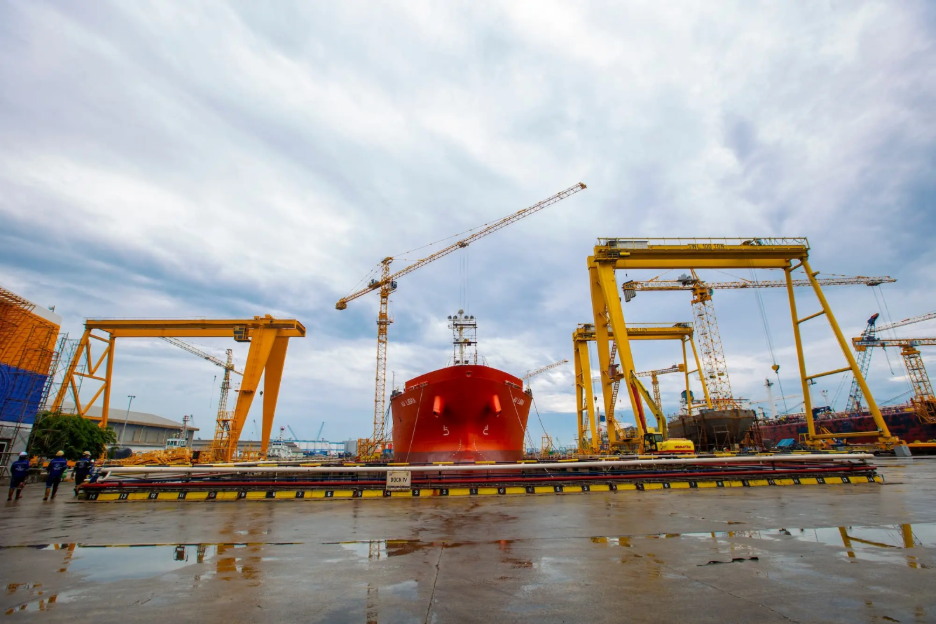
A gantry crane is a type of lifting equipment designed to lift and move heavy materials both vertically and horizontally.
It features a horizontal beam, known as a girder, supported by two main legs that form a portal-like structure. The bottom of each supporting leg is fitted with wheels or a rail system, allowing the crane to travel along a designated path.
Gantry cranes are commonly used in open operational areas, such as ports, shipyards, construction sites, and manufacturing facilities. Their mobility allows them to cover large work areas without relying on a building's structural framework for support.
Main Components of a Gantry Crane
A gantry crane consists of several interconnected components that work together to lift and move heavy loads. Here are some of its main components:
1. Frame
The frame is the main structural component of a gantry crane. It supports the entire assembly and keeps the crane stable during operation.
It is typically made of high-strength steel or aluminum, with a combination of beams and supports designed to distribute loads evenly.
2. Trolley
The trolley carries the hoist and moves the load horizontally along the gantry crane's main beam. Its movement is powered by an electric motor, wheels, and a gear system, allowing operators to position loads at the required transfer points.
3. Hoist
The hoist is responsible for raising and lowering loads. It consists of several mechanisms, including a motor, gearbox, drum, and wire rope.
The motor drives the drum to wind or unwind the wire rope, allowing loads to be lifted or lowered in a controlled manner.
4. Wheels
The wheels support the gantry crane and allow it to move along its designated operating track. They are generally made of high-strength steel to withstand heavy loads and repeated use.
Read also: The World's Largest Tankers, Including One from Indonesia!
Types of Gantry Cranes
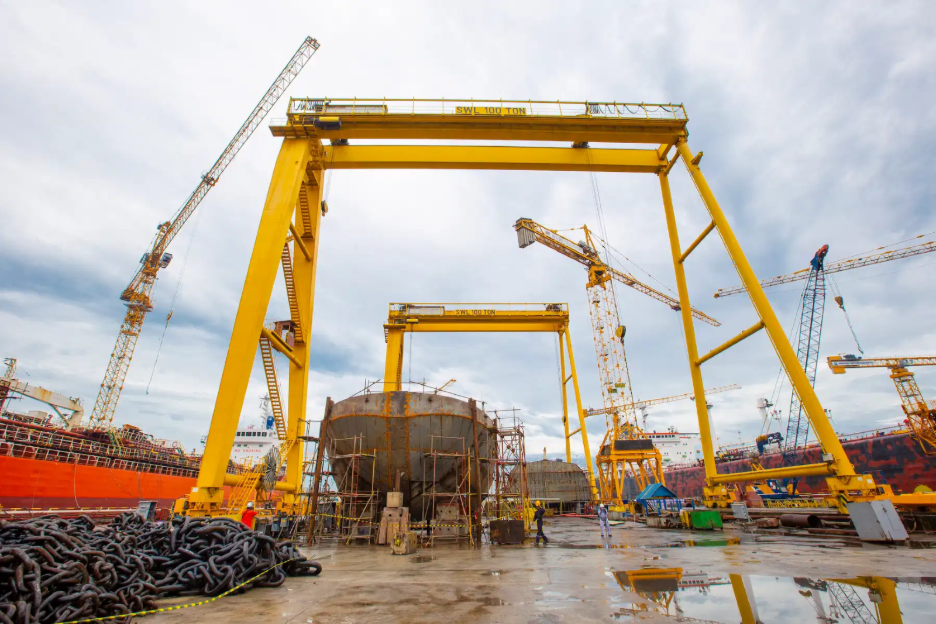
Gantry cranes come in various designs and configurations, each offering different structural features and lifting capabilities. The following are some of the most commonly used types in industrial operations:
1. Single Girder Gantry Crane
A single girder gantry crane uses one main beam to support its lifting mechanism. This design makes the crane relatively lightweight and generally easier to maintain.
It is commonly used to handle light to medium loads in workshops, warehouses, and small to medium-sized manufacturing facilities.
2. Double Girder Gantry Crane
Unlike the single girder type, a double girder gantry crane features two main beams to support its lifting mechanism.
This configuration provides greater structural strength, allowing the crane to handle heavier loads and cover wider working areas. It is commonly used in heavy industries, ports, shipyards, and large-scale construction projects.
3. Full Gantry Crane
A full gantry crane features two supporting legs that carry the entire main structure. Both legs are fitted with wheels or a rail system, allowing the crane to travel across the operating area.
Its robust construction makes it suitable for heavy lifting operations in open spaces, such as shipyards and steel manufacturing facilities.
4. Semi Gantry Crane
A semi gantry crane features a design in which one side is supported by a crane leg, while the other runs along a supporting structure or rail mounted on a building.
This configuration allows the crane to operate both inside and outside buildings while making efficient use of the available space. It is commonly found in factories and warehouses with limited operating areas.
5. Portable Gantry Crane
A portable gantry crane is designed to be easily moved from one work area to another. It generally has a smaller frame and is equipped with wheels for greater mobility.
Its lifting capacity is typically lower than that of larger industrial cranes, making it more suitable for light to medium-duty lifting tasks in workshops, garages, and warehouses.
6. Adjustable Gantry Crane
An adjustable gantry crane features a frame that can be modified to accommodate different dimensions, particularly its height and width.
This flexibility allows operators to handle loads of varying sizes and work in areas with limited clearance. It can be used in various settings, including factories, warehouses, construction sites, and shipyards.
7. Truss Gantry Crane
A truss gantry crane uses a lattice-like framework as part of its main structure. This design helps reduce the crane's overall weight while maintaining the structural strength and stability needed for lifting operations.
It is suitable for outdoor applications and locations where ground load-bearing capacity is a consideration. Depending on the lifting requirements, its structure can incorporate either a single or double main girder.
8. Box Girder Gantry Crane
A box girder gantry crane uses a main beam with a hollow, box-shaped cross-section. This structural design provides additional strength and rigidity to support loads during lifting operations.
It is commonly used in large-scale infrastructure projects and industrial applications that require high lifting capacities.
9. Container Gantry Crane
A container gantry crane is specifically designed to handle shipping containers during loading and unloading operations at ports and container terminals. It is used to transfer containers between vessels and designated storage areas on land, and vice versa.
One common type is the rubber-tyred gantry (RTG) crane, which uses rubber tires instead of fixed rails, allowing it to move freely around the container terminal.
Read also: Types LPG Carriers for Liquefied Gas Distribution
Gantry Crane Lifting Capacity
The lifting capacity of a gantry crane refers to the maximum weight it can safely handle in a single lifting operation. Below are some common lifting capacities used in industrial applications:
- 1–2 tons: Suitable for light lifting tasks in smaller work areas, such as garages, workshops, warehouses, and other workspaces. This capacity is commonly available in single girder and portable gantry crane models.
- 3–5 tona: Ideal for light to medium-duty lifting operations in workshops, warehouses, manufacturing facilities, and port areas. Cranes in this capacity range may feature either a single or double girder configuration, depending on their design.
- 10–15 tons: Designed to handle medium to heavy loads, particularly in manufacturing and construction operations. This capacity can also be a suitable option when building structures cannot accommodate overhead cranes supported by the building framework.
- 20 tons: Capable of handling heavy materials for both indoor and outdoor operations. These cranes are available in single or double girder configurations, depending on the specific lifting requirements.
- 30 tons: Commonly used in infrastructure projects and heavy industrial operations that involve moving large and heavy materials. The crane's design and configuration can be customized to suit the conditions of the work area.
- 50–100 tons: Designed for heavy-duty lifting operations in large-scale industrial environments, such as ports and shipyards. Cranes in this capacity range generally use a double girder configuration to provide adequate structural support. Waruna Group also offers gantry cranes with lifting capacities within this range.
What to Consider When Choosing a Gantry Crane
Choosing the right gantry crane requires careful consideration of your lifting requirements and operating conditions. Here are several key factors to evaluate before making a decision:
- Match the lifting capacity to your requirements: Choose a gantry crane based on the maximum weight of the materials you need to lift. Make sure its rated capacity is sufficient for your operational requirements, and that loads never exceed the crane permitted lifting limit.
- Check structural quality and safety features: Ensure that the crane materials and structural design can safely support its rated capacity. You should also check for relevant safety standards or certifications, as well as essential features such as overload protection and emergency stop buttons.
- Consider the operating and control features: Select a crane with a control system that suits your operational needs. Features such as control panels, remote controls, and automation systems can help operators manage crane movements more effectively and improve material handling efficiency.
Read also: 10 Types of Barges Used in Maritime Logistics
Choose Waruna Group's ISO-Certified Shipyard Services for Your Vessel Maintenance Needs
The use of gantry cranes in shipyards helps lift and move heavy materials during vessel repair and construction work.
These activities require reliable equipment and work procedures that prioritize quality and safety. Therefore, when choosing a shipyard, you should not only consider the available facilities but also the operational management standards it applies to.
Waruna Group is a company engaged in the maritime industry, providing various services to support the shipping industry. One of these is Shipyard Services, operated by PT Waruna Shipyard Indonesia (WSI).
Our shipyard facilities are equipped with seven docks, supporting various projects ranging from routine vessel repairs to newbuilding works. Our largest dry dock can accommodate vessels with a deadweight tonnage (DWT) of more than 100,000.
We also place strong emphasis on regular maintenance and inspection standards to ensure the reliability of our equipment. These inspections consist of two types, which include both internal and external inspections. At WSI, internal inspections are conducted twice a year by WSI's QC Inspector I. Meanwhile, external inspections are carried out annually by an Occupational Health and Safety (OHS) Specialist Inspector for Lifting and Transport Equipment from the local Manpower Office.
These two standards are related to quality management systems and occupational health and safety (OHS) management systems, respectively.
WSI's Shipyard Services cover several areas of work, including machinery, mechanical works, blasting and painting, and lifting equipment.
Each service is supported by personnel who continuously develop their knowledge and skills in their respective fields. This reflects Waruna Group's position as a trusted maritime partner in Indonesia for more than 35 years.
Get support for your vessel's needs through WSI's Shipyard Services, which comply with ISO 9001:2015 and ISO 45001:2018 standards. Contact our team today to discuss your vessel's operational requirements.