
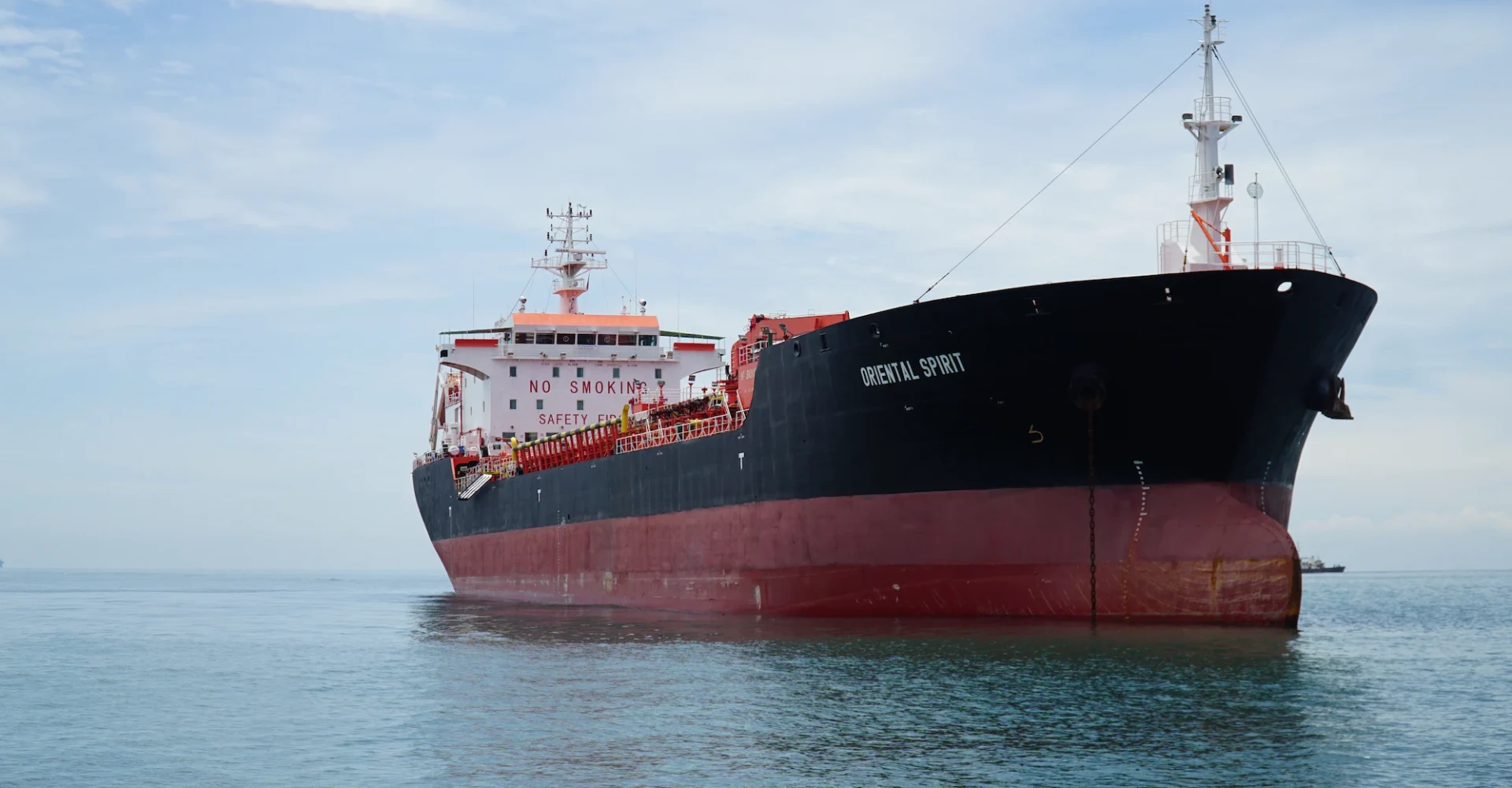
In shipping operations, a vessel’s carrying capacity is not determined solely by the amount or volume of cargo it can accommodate. There is also a weight limit that must be taken into account to ensure the vessel can operate safely throughout its voyage.
A ship’s Deadweight Tonnage (DWT) is one of the key measurements used to determine this weight limit. So, what exactly is DWT, and how does it affect a vessel’s carrying capacity and operational performance? Read on to explore the full explanation!
Definition of Ship DWT
Deadweight Tonnage (DWT) is a measurement of the total weight a vessel can safely carry, including cargo, fuel, fresh water, provisions, crew, and other supplies, up to its assigned load line.
Calculating a vessel’s DWT is essential to ensure that its total load does not exceed the permitted carrying capacity.
This calculation also helps maintain vessel stability, manage the ship’s draft, and ensure that the load line (Plimsoll mark) remains within the limits established by maritime safety regulations.
As a result, the risk of overloading, which could endanger the vessel during operations, can be minimized. Beyond its role in ensuring safety, DWT is also an important consideration in operational and logistics planning.
Shipping companies use DWT to select vessels that meet specific transportation requirements, estimate cargo capacity, and ensure that vessels are suitable for the depth limitations of shipping channels and port facilities.
Therefore, DWT information helps shipowners and charterers determine fleet capacity and assess operational requirements more accurately.
Components Included in DWT Calculation
When calculating a vessel’s DWT, several components must be taken into account, as each contributes to the total weight carried by the vessel during its operations.
These components include not only the cargo being transported but also operational necessities and the people on board. The following are the components included in the calculation of Deadweight Tonnage:
- Cargo or freight
- Fuel
- Fresh water
- Ballast water
- Provisions
- Crew and their personal belongings
All these components are added together to determine the total weight carried by the vessel.
Therefore, the available cargo capacity must also account for the weight of fuel, water, provisions, and other operational necessities required throughout the voyage.
Read also: Tugboats: Small Vessels with a Vital Role in Maritime Industry
How to Calculate a Ship's DWT
A vessel’s DWT is calculated by determining the difference between its total weight at maximum load capacity and its weight in an empty condition.
To better understand the calculation, Deadweight Tonnage can be determined using the following formula:
DWT = Full Load Displacement - Lightweight
Where:
- Full Load Displacement: The total weight of the vessel when floating at its maximum assigned load line. This includes the vessel's own weight, cargo, fuel, water, crew, and operational equipment.
- Lightweight (Lightship Weight): The weight of the vessel in an empty condition, excluding cargo, fuel, water, crew, and provisions.
Example of DWT calculation:
For example, suppose a vessel has a Full Load Displacement of 72,000 tonnes and a Lightweight of 24,000 tonnes. Based on these figures, the DWT can be calculated as follows:
DWT = 72,000 − 24,000 = 48,000 tonnes
Based on this calculation, the vessel has a maximum deadweight capacity of 48,000 tonnes. This figure represents the total additional weight the vessel can carry, not just its cargo capacity.
Therefore, the weight of fuel, fresh water, ballast water, provisions, and crew, including their personal belongings, must also be taken into account to ensure that the total load does not exceed the permitted limit.
In practice, a vessel’s DWT is generally established during the design and technical assessment stages, taking into account its buoyancy characteristics and applicable load line regulations.
For this reason, vessel operators use the assigned DWT as a reference when managing the total load throughout a voyage, rather than recalculating it manually every time the vessel operates.
Read also: Types LPG Carriers for Liquefied Gas Distribution
Comparing DWT with Other Types of Ship Tonnage
Carrying capacity is not the only factor used to describe a vessel’s characteristics. Other measurements are also used to determine the volume of a vessel’s spaces and its weight under specific conditions.
To help you better understand the differences, the following table compares DWT with several other types of ship tonnage.
|
Types of Tonnage |
Measurement |
Main Purpose |
|
Deadweigt Tonnage (DWT) |
The total weight a vessel can carry. |
Determines carrying capacity and supports vessel operational planning. |
|
Gross Tonnage (GT) |
The total volume of all enclosed spaces within a vessel. |
Serves as the basis for safety regulations, legal requirements, and vessel registration. |
|
Net Tonnage (NT) |
The volume of spaces available for commercial use. |
Serves as a reference for determining port dues and canal charges. |
|
Displacement Tonnage |
The total weight of a vessel when floating. |
Supports vessel stability analysis and ship design. |
|
Light Displacement Tonnage (LDT) |
The weight of a vessel in its empty condition. |
Serves as a reference for calculating DWT and assessing vessel assets. |
As shown in the table, each type of tonnage provides different information about a vessel's condition and characteristics.
DWT focuses on the total weight a vessel can carry, while GT and NT are related to the volume of the vessel's spaces. Meanwhile, Displacement Tonnage and LDT describe the vessel's weight under specific conditions.
Read also: Barges in the Maritime Industry: Functions and Types
DWT Capacity Across Different Vessel Types in Waruna Group
To support smooth sea distribution, Waruna Group provides Shipping Services with a diverse fleet offering various DWT capacities.
With more than 35 years of experience as a maritime partner, Waruna Group is well-equipped to meet sea transportation needs across various industry sectors.
Below are the DWT capacity range of different vessel types operated by Waruna Group:
Oil Tankers
Waruna Group operates more than 50 oil tankers, with DWT capacities ranging from 16,636 to 107,200 DWT. Below are several examples of its fleet and their carrying capacities:
|
Vessel Name |
Vessel Type |
DWT |
|
MT SUMMER PALACE |
General Purpose |
16.636 DWT |
|
MT PEARL ORCHID |
General Purpose |
19.980 DWT |
|
MT MADONNA SUN |
Medium Range |
30.561 DWT |
|
MT ATLAS LINK |
Medium Range |
106.029 DWT |
|
MT NECTAR |
Long Range |
105.317 DWT |
|
MT STAR VALIANT |
Long Range |
107.200 DWT |
Bulk Carriers
Waruna Group provides bulk cargo transportation and chartering services for private companies and state-owned enterprises (SOEs) across various regions of Indonesia.
Its available fleet offers DWT capacities ranging from 28,382 to 57,283 DWT. Some vessels are also equipped with cranes to support cargo loading and unloading operations at ports with limited shore-side facilities.
Below are several examples of its vessels and their respective capacities:
|
Vessel Name |
Vessel Class |
DWT |
|
MV GOLDEN DESTINY |
Handymax |
28.382 DWT |
|
MV PAN GLORY |
Supramax |
57.283 DWT |
Cement Carriers
Waruna Group provides cement transportation and chartering services to support the needs of cement manufacturers, contractors, and distributors. Its operational network covers major ports and industrial areas across various regions of Indonesia.
Waruna Group's cement carriers have DWT capacities ranging from 6,243 to 8,581 DWT. Below are several examples of its fleet and their respective capacities:
|
Vessel Name |
DWT |
|
MV CEMCON |
6.243 DWT |
|
MV CEMTRANS |
7.345 DWT |
|
MV MARTHA GOLDEN |
8.581 DWT |
Waruna Group operates a fleet with varying DWT capacities to support the transportation of different commodities.
Each vessel has its own characteristics and carrying capacity to meet specific distribution requirements, ranging from oil and dry bulk cargo to cement.
In addition to oil tankers, bulk carriers, and cement carriers, Waruna Group's Shipping Services also include the chartering and operation of LPG tankers, harbour tugs, and tug and barge vessels.
With hundreds of vessels across various classes, Waruna Group supports the transportation of energy and commercial commodities to key destinations throughout Indonesia, across the ASEAN region, and to other international markets.
Backed by extensive maritime industry experience and a wide operational network, Waruna Group is committed to meeting the sea transportation needs of businesses across various sectors.
If your company requires sea transportation solutions for energy products or other commodities, explore Waruna Group's Shipping Services to support your distribution operations.
Contact Waruna Group to learn more about its fleet options and services tailored to your operational requirements.