
When a vessel stops in open water, its position needs to be secured to prevent it from drifting due to currents or waves. This requires specialized equipment that can keep the vessel in its designated anchorage without having to rely continuously on its propulsion system.
One of the essential pieces of equipment is the ship anchor, which plays an important role in supporting safe and efficient vessel operations.
The type of anchor used must also be suited to the vessel's characteristics. So, what are the different types and components of ship anchors, and how do they work? Read on to find out more!
About Ship Anchors
A ship anchor is an essential piece of equipment used to help keep a vessel in position in the water. The anchoring system itself consists of several components that work together, including the operating mechanism, connecting chain, and anchor, which grips the seabed.
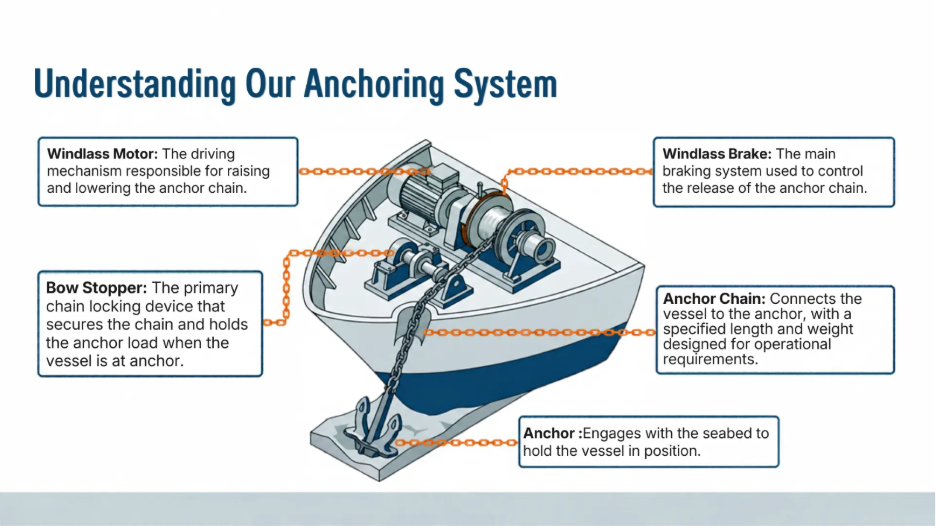
The anchor is lowered until it reaches the seabed or the bottom of another body of water, helping prevent the vessel from drifting due to currents and waves.
Ship anchors are generally made from metal materials that offer strength and durability in marine environments. Carbon steel is one of the most commonly used materials because it can withstand the loads and pressure exerted during anchoring.
Other materials include stainless steel and galvanized steel, which offer better resistance to corrosion caused by exposure to seawater.
Components of Ship Anchors
In general, the components of a ship's anchoring system can be divided into two main groups: anchoring equipment and the structural components of the anchor itself.
A. Anchoring Equipment
These components support the operation and control of the anchoring system, as well as help secure the anchor chain. They include:
1. Windlass Motor
he motor that drives the windlass is responsible for operating the mechanism that raises and lowers the anchor chain. It allows the crew to control the anchor movement as needed.
2. Windlass Brake
The windlass braking system controls and holds the anchor chain as it is paid out. This component helps ensure that the anchor is lowered in a controlled manner.
3. Anchor Stopper
The anchor stopper secures the anchor chain and prevents it from moving once the vessel is at anchor. It helps bear the load exerted by the chain, reducing the strain on the windlass braking system.
4. Anchor Chain
The anchor chain connects the anchor to the vessel and transfers the pulling force during anchoring. Its length and weight also affect the stability of the anchoring system and the vessel's ability to maintain its position.
B. Physical Components of a Ship Anchor
The following components make up the anchor's structure and help it grip the seabed:
1. Shank
The main shaft that connects the anchor's flukes to the anchor chain. It transfers the pulling force from the chain to the anchor body.
2. Fluke
The broad, pointed part of the anchor is designed to dig into and grip the seabed. Its shape and number may vary depending on the anchor type.
3. Crown
The part that connects the shank to the flukes. It helps guide the flukes into a position when the anchor makes contact with the seabed.
4. Stock
A crossbar fitted to certain types of anchors. It helps orient the anchor so that one of its flukes can dig into the seabed.
5. Tripping Palm
An additional feature found on certain anchor designs. It helps release the anchor from the seabed when it is time to retrieve it.
6. Anchor
The complete anchoring device that is lowered to the seabed to grip its surface. Together with the anchor chain, it helps keep the vessel in position while at anchor.
Functions of a Ship Anchor
A ship anchor plays an important role in ensuring safe and smooth vessel operations. Here are some of its key functions:
- Keeping the vessel in position: Holds the vessel at a designated location and prevents it from drifting due to currents, waves, or wind.
- Supporting emergency control: Helps limit vessel movement in the event of engine failure or steering system problems.
- Assisting vessel maneuverability: Helps control the vessel's direction or movement when operating in narrow waterways.
- Maintaining position during specialized operations: Keeps the vessel in place during activities such as underwater surveys and drilling operations.
- Improving safety at anchor: Reduces the risk of the vessel drifting away from its anchorage due to changing water conditions.
Read also: The World's Largest Tankers, Including One from Indonesia!
Ship Anchor Weight
Anchor weight is an important factor to consider when selecting a vessel's anchoring equipment. The required weight depends on the vessel's size, type, and operational needs. As a general guide, anchor weights can be grouped according to vessel size as follows:
- Small boats and vessels (up to 6 meters long): Typically use anchors weighing around 2–5 kg.
- Recreational boats and sailing vessels (6–9 meters long): Generally require anchors weighing around 6–10 kg.
- Medium-sized vessels (9–12 meters long): Usually use anchors weighing around 10–20 kg.
- Large vessels (12–15 meters long): Generally require anchors weighing around 15–30 kg.
- Vessels over 15 meters long: Use anchors weighing 30 kg or more, depending on the vessel's size and tonnage.
Meanwhile, large commercial vessels, such as tankers, may use anchors weighing hundreds of kilograms or even several tons. For example, anchors on large vessels can weigh around 1,000–5,000 kg or more.
These differences highlight the importance of selecting an anchor weight that matches the vessel's characteristics to ensure it can meet operational requirements at sea.
Types of Ship Anchors
Ship anchors come in various types, each with distinct features and applications. These differences can be seen in their structural design as well as their installation positions on a vessel. The following are some of the main types of ship anchors:
1. Types of Ship Anchors Based on Their Design
Ship anchors come in a range of designs, each suited to different operational requirements and vessel characteristics. Here are some common types based on their shape and function:
- Scream Anchor: This anchor is used as a supplementary anchor to the bow anchor or current anchor, particularly when a vessel is anchored in waters with strong currents. It helps hold the stern in position and keeps the vessel stable.
- AC-14 Anchor: The AC-14 is a high-holding-power (HHP) anchor designed to provide strong holding capacity. It is commonly used on commercial vessels and aquaculture vessels due to its high holding efficiency relative to its weight.
- Hall Anchor: This type of anchor is widely used on commercial vessels and cargo ships. It features an open, dish-shaped base and two upper arms that resemble a trident.
- Spek Anchor: The Spek anchor has a design similar to the Hall anchor, but its base is enclosed rather than open. It is also commonly used on commercial vessels and cargo ships.
- Danforth Anchor: Features two wide flukes designed to grip the seabed. It is commonly used on small vessels, such as boats, and provides good holding power in sandy or muddy seabeds.
- Stevin Anchor: Designed for offshore operations that require high holding capacity, this anchor has a robust construction that allows it to withstand heavy loads in demanding operating conditions.
Read also: Types LPG Carriers for Liquefied Gas Distribution
2. Types of Ship Anchors Based on Their Placement
In addition to their design, ship anchors can also be classified according to where they are stored or installed on a vessel. Some of these types include:
- Danforth Stock Anchor: This anchor is fitted with a crossbar (stock) that helps position its flukes to grip the seabed. It provides good holding power on both sandy and muddy seabeds. It is generally stored on the orlop deck and can serve as a spare anchor.
- Mushroom Anchor: As its name suggests, this anchor has a mushroom-like shape, with a wide, bowl-shaped base. It is commonly used on small vessels, particularly those operating in muddy waters, as its shape helps it remain embedded in the seabed.
- Stockles Bow Anchor: This type of anchor has no stock and features a head that allows its flukes to pivot. It is widely used as the main anchor on large vessels and is typically installed on both the port and starboard sides of the bow.
How Does a Ship Anchor Work?
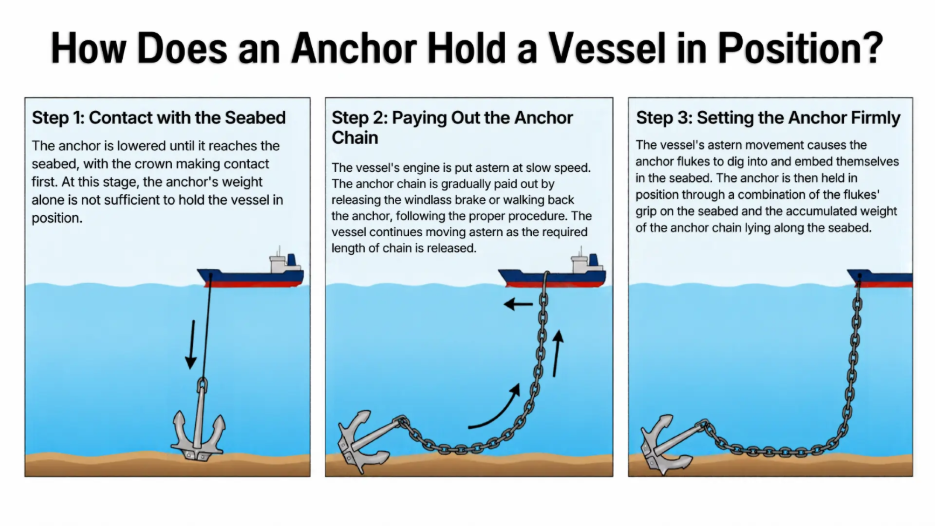
Using a ship anchor involves several stages, from lowering it to the seabed to monitoring its position once it has set. The process generally follows these steps:
1. Lowering the Anchor
The crew lowers the anchor using a windlass or winch until it reaches the seabed. At this stage, the anchor crown typically makes contact with the seabed first. The lowering speed and length of chain released are adjusted according to standard procedures to ensure the process remains controlled.
2. Paying Out the Anchor Chain
Once the anchor reaches the seabed, the vessel slowly moves astern while the anchor chain continues to be paid out. The amount of chain released is determined by the required scope and operating procedures, allowing the chain to lie along the seabed.
3. Setting the Anchor
As the vessel moves astern, tension is applied to the anchor chain, causing the anchor flukes to dig into the seabed. The anchor's grip, combined with the weight of the chain lying on the seabed, provides the holding force needed to keep the vessel in position.
4. Monitoring the Vessel's Position
Once the anchor is set, the crew monitors the vessel's position and the anchor's condition to ensure that neither shifts while the vessel remains at anchor.
Read also: Tugboats: Small Vessels with a Vital Role in Maritime Industry
Entrust Your Vessel Maintenance to Waruna Group's Shipyard Team
Ship anchors need to be inspected and maintained regularly to ensure they function properly when a vessel needs to remain in position at sea.
Exposure to seawater and the loads exerted during operation can affect the condition of both the anchor and its chain. For this reason, regular inspections and maintenance of vessel equipment are essential.
These maintenance needs can be handled through Waruna Group's Shipyard Services. Managed by PT Waruna Shipyard Indonesia (WSI), the shipyard is equipped with six docks and has a capacity of up to 120,000 DWT.
WSI's Shipyard Services cover several areas of work, including machining, mechanical services, blasting and painting, and lifting equipment.
In terms of management, PT Waruna Shipyard Indonesia has implemented management systems aligned with the international standards ISO 9001:2015 and ISO 45001:2018. ISO 9001:2015 focuses on quality management systems, while ISO 45001:2018 addresses occupational health and safety management systems.
Waruna Group also supports the maritime industry through its Shipping Services. We operate a fleet of more than 150 vessels across various categories, including oil tankers, LPG tankers, bulk carriers, harbour tugs, tugboats and barges, and cement carriers.
This diverse fleet supports the transportation of energy and business commodities to destinations across Indonesia, including remote areas, as well as several locations throughout ASEAN and beyond.
With more than 35 years of experience in Indonesia's maritime industry, Waruna Group continues to strengthen its operations with hundreds of vessels across various classes and a network that covers key locations throughout the country.
This experience reinforces Waruna Group's role in supporting the needs of the shipping and commodity distribution sectors.
If your vessel requires maintenance or repair, contact our team to learn more about WSI's ISO-certified Shipyard Services and comprehensive facilities.